How people perceive your brand personality is subjective – but extremely important. According to Harvard Business School, 95% of purchasing decisions are based on feelings instead of logic. We form gut-level impressions of brands much like we do with people: some feel warm and inviting, while others come off edgy or aloof. Those emotional reactions shape whether we notice you, trust you and ultimately buy from you. In other words: having a great product isn’t enough – you need a great, human brand personality to match.
This guide covers the foundations of brand personality, practical steps for design and voice, real-world case studies, common pitfalls and how to evolve personality over time.
- Align personality to a target audience first, personal taste comes second.
- Use frameworks (Aaker, Jungian archetypes, OCEAN) to sharpen traits – then mix intentionally.
- Translate traits into tangible choices: logo, color, type, imagery, tone, packaging and campaigns.
- Prototype and validate early to prevent tone drift.
- Evolve deliberately, keep continuity while refreshing what no longer serves.
What is brand personality?
Brand personality is a set of characteristics attributed to a brand in the eyes of a customer. A brand’s personality is what shapes the public perception of a brand based on how it acts, what it says and what it looks like. It’s the vibe or feelings your brand gives – how it comes across to newcomers and loyal customers alike.
A well-defined personality can attract your ideal audience and repel the wrong fit. The key is to shape it proactively and express it consistently across touchpoints: product, website, content, social, packaging, customer service tone, even tiny bits of microcopy.

What makes a brand personality successful
While the approaches, strategies and even the personalities themselves vary from company to company, the actual goals of brand personality remain consistent for everyone. Looking at branding as a whole, you want your brand personality to satisfy these five areas:
- Authenticity: Your brand personality should always reflect your business goals and company culture. A law firm of traditional, old guard lawyers could not pull off a young and rebellious brand personality. Younger consumers especially are starting to catch on when a company is sincere and when it’s cashing in on a trend.
- Memorability: Particularly important for new brands, you need to stand out to be remembered. A funny visual, play on words or extraordinary gesture can turn an unknown startup into a household name.
- Value: The “substance” of your business: what value do you provide for customers that they can’t get elsewhere? A product type, quality, price or even way to identify themselves? Your brand personality should complement your business model.
- Trustability: Every pizza place in New York claims to be the best, but only one of them can be telling the truth. Just like a real person, if your brand lies about who it is, people will stop listening.
- Authority: Customers expect the brands they do business with to be experts in their field. A brand personality that confidently and helpfully owns who they are will attract more business.
Aaker’s dimensions
Once you’ve sketched out your brand personality in words, the next step is turning it into concrete marketing choices. Aaker’s Brand Personality Dimensions are a helpful shortcut. They group brand personalities into five sections:
- Sincerity: Honest, wholesome, down-to-earth. In marketing, sincerity shows up through warm, friendly copy, real customer photos and behind-the-scenes content that feels human and unpolished. For example, a local bakery might use handwritten labels, staff stories and soft, natural colors to signal that it’s genuine and approachable.
- Excitement: Daring, spirited, imaginative. This often translates into bold colors, dynamic layouts and energetic social campaigns. A new fitness app could lean on punchy headlines, motion graphics and challenge-based campaigns to keep energy high and encourage sign-ups and shares.
- Competence: Reliable, successful, intelligent. Competent brands tend to use clean design, data-backed claims and strong testimonials or case studies. A B2B software brand might feature simple charts, clear feature comparisons and professional photography to communicate that it is trustworthy and capable.
- Sophistication: Upscale, refined, charming. In marketing, this can mean minimal layouts, elegant typography and high-end imagery. A boutique skincare line may choose muted tones, lots of white space and close-up product shots to convey luxury and care.
- Ruggedness: Tough, outdoorsy, strong. Rugged brands often use textured visuals, natural backdrops and adventurous lifestyle photography. An outdoor gear brand could show trail photos, muddy boots and direct, no-nonsense copy to reinforce strength and durability.
To keep your brand both recognizable and distinctive, balance your categories with a few elements you intentionally break for standout value – like an unexpected accent color, a surprising tone of voice or a playful illustration style. You can also define your mix as a simple ratio, such as 70% Competence, 30% Excitement, and let that blend guide your logo form, color palette, typography, imagery style and copy rhythm.
Jungian archetypes
While Aaker helps with traits, Jungian archetypes help you think of your brand as a character in a story. Archetypes are recurring roles we instantly recognize – like the hero or the caregiver – and make your marketing feel more coherent and emotionally engaging. Commonly used archetypes include:
- The Hero: Help people overcome challenges and achieve big goals. In marketing, this often shows up as motivational language, transformation stories and before-and-after case studies – for example, a sports brand highlighting customer wins and “you can do this” messaging.
- The Caregiver: Protect, support and nurture, using a reassuring tone, support-focused visuals and customer care stories, like a healthcare provider featuring patient success stories and practical how-to guides.
- The Explorer: Encourage discovery and freedom, using adventurous imagery and “find your own path” messaging, which suits a travel agency promoting off-the-beaten-path itineraries with user-generated travel photos.
- The Jester: Bring fun and lightness, weaving humor into copy and playful visuals, as you might see from a snack brand that uses jokes on packaging and social content.
- The Sage: Share wisdom and expertise, typically through educational content, in-depth guides and webinars, such as a consultancy publishing thought-leadership articles and research reports.
You don’t need to use all archetypes. Instead, choose one primary archetype that represents your main role in customers’ lives, and, if helpful, a secondary archetype that adds nuance – for example, a sage-caregiver or hero-explorer blend.
OCEAN
Finally, OCEAN (the Big Five personality traits) helps you connect brand personality to how you behave in different channels day-to-day.
- Openness: Experimentation and discovery. Brands high in openness are more likely to try new formats – like reels, pop-ups or interactive tools – and share “behind the scenes” experiments. A design studio might regularly post work-in-progress concepts on Instagram and ask followers to vote, turning its curiosity into engagement.
- Conscientiousness: Clarity and reliability. In marketing, this can look like a consistent posting schedule, clear instructions and accurate product details. An e-commerce shop that always confirms shipping timelines, sends reminders and follows up after delivery shows customers it can be counted on.
- Extraversion: Bold, outward-facing energy. Extraverted brands are highly visible on social media, run events, host live Q&As and run referral programs. A local gym might host regular live workouts and community events, plus share daily stories to keep momentum high.
- Agreeableness: Empathy and collaboration. Agreeable brands use customer-first language, focus on community building and offer quick, warm support responses. A SaaS brand that openly requests feature feedback, runs user groups and showcases customer ideas in product updates demonstrates that it listens and cares.
- Neuroticism: How a brand appears under pressure. Low neuroticism in marketing means steady, reassuring messaging during problems such as delays, issues or broader market changes. A delivery service that communicates proactively during disruptions, offering clear, calm updates and solutions, helps maintain trust even when things go wrong.
You can again define a simple profile – say, high Conscientiousness and Agreeableness, medium Extraversion and Openness and low Neuroticism – and then translate that into concrete marketing behaviors, such as how quickly you respond to customers, how often you experiment with new content and how transparent you are about mistakes or changes.
From brand personality to creating an identity
Your brand personality framework is the human characteristics of your brand – a happy brand, an energetic brand, a no-nonsense brand, an utterly clueless brand. Your brand identity, on the other hand, is the manifestation of your brand personality, like your logo, your color scheme or the tone of voice you use in your blog. If you understand programming, you can think of brand personality as the back end, the behind-the-scenes stuff, and brand identity as the front end, what the user sees.

Knowing how your brand personality framework will be presented helps when initially determining the traits and vibes you want to associate with. To better understand the branding process from start to finish, consider these main components of a brand identity:
- Color scheme: According to color theory, each color elicits a specific emotional response from viewers, which is why brands within the same industries tend towards the same colors.
- Shapes: Like colors, the shapes you use in branded images like logos can also elicit emotions. For example, circles and curves are more playful and welcoming, but rigid rectangular shapes denote more serious brands. For further info, read more about the meanings of logo shapes.
- Typography: How your text looks is almost as important as what it says. The fonts, styles and sizes of your typography can communicate independently of the words they represent.
- Brand voice: It’s not always about how you look, customers draw conclusions about your brand personality based on how you speak in your social media, websites, blogs, ad, press releases, etc. For a deeper dive, read a complete guide on building your brand voice.
- Imagery: Choose subjects, lenses and lighting that match traits (documentary realism vs. stylized fantasy, candid vs. composed).
- Packaging: Materials, structure and unboxing signal craft, sustainability or playfulness; structural choices can embody ruggedness or refinement.
- Campaigns: Build platforms that prove traits (a “helpful” brand funds tutorials and tools; a “bold” brand stages high-energy stunts with responsible guardrails).
How to develop the best brand personality
As we said above, while the goals of brand personality may be the same for everyone, the approaches should be molded by your unique business. In other words, the destination is the same, but how you get there depends on you.
Cater to your target audience
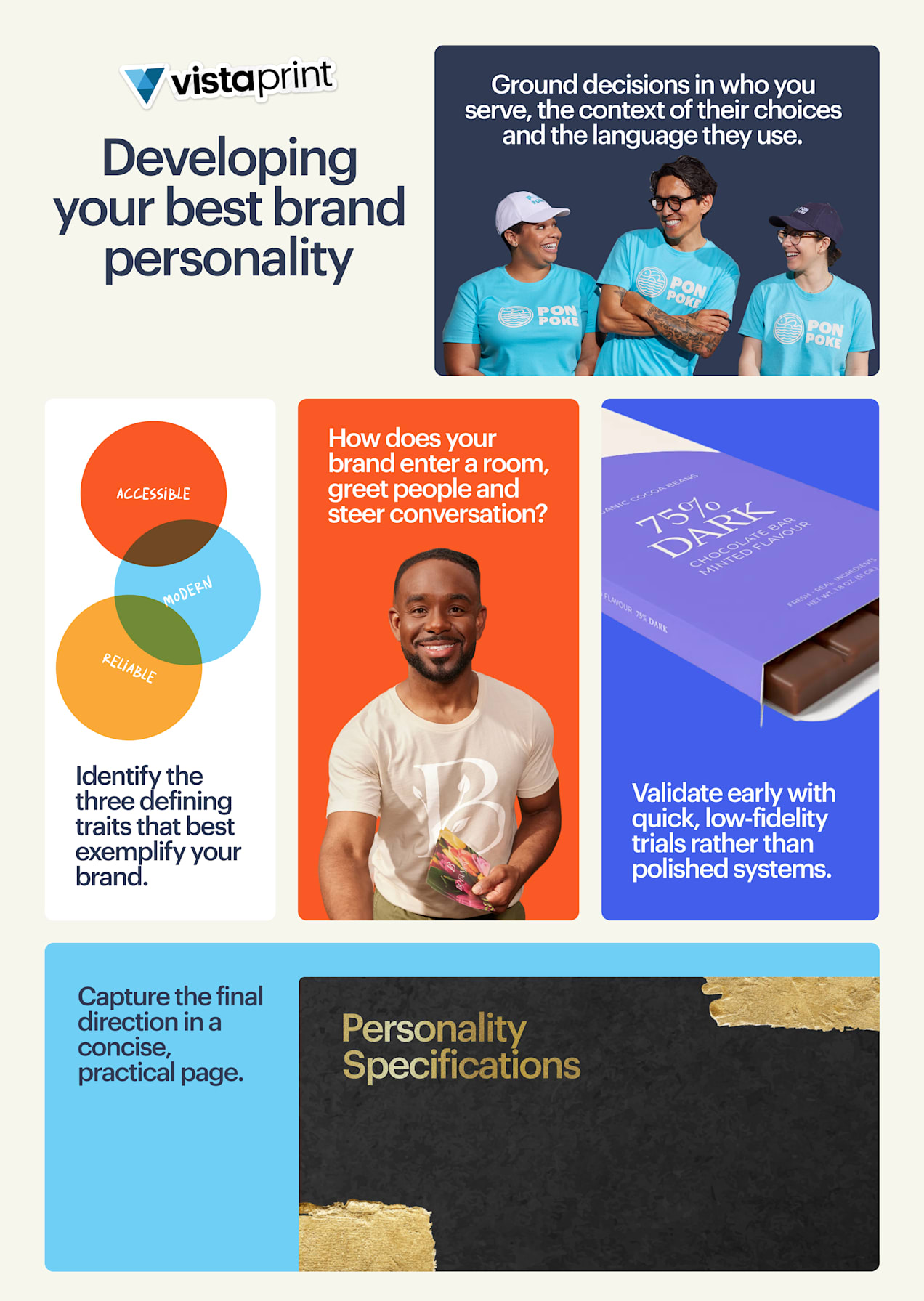
Personality–market fit matters because the same traits can attract one audience and give the ick to another. Ground decisions in who you serve, the context of their choices and the language they use. Prioritize evidence over internal taste: do brand research, paying attention to brand persona, brand pillars, brand psychology and branding vs. marketing. Use surveys to see which attributes are most popular and pair them with interviews and social listening to uncover motivations and anxieties.
Collect the findings, note gaps between what people say and do and choose cues that resolve those tensions. When you can describe your audience’s world in their words, your personality will feel precise and credible.

Draft and prioritize traits
Start broad, then cluster and narrow to a small, potent set of traits You should end up with three defining traits, and assign explicit weights – your base note and two accents – so trade-offs are easy to resolve. Pressure-test by writing a few lines of copy, sketching a logo direction and imagining a support reply; if the same trio yields coherent choices across scenarios, you’ve got the right mix. If not, adjust the weights instead of adding more traits. A focused set creates clarity, and clarity reads to customers as confidence.
Personify the brand
Personify the brand to move from abstractions to specifics. Picture how it enters a room, greets people and steers conversation; notice whether it’s direct or storytelling, cautious or provocative. Translate the “wardrobe” into visual rules – palette restraint or exuberance, typography that’s tailored or casual, imagery that’s candid or composed. When the persona feels real enough that writers and designers can “hear” it, micro-decisions align naturally and the system becomes self-consistent.
Validate with prototypes
Validate early with quick, low-fidelity artifacts rather than polished systems. Create a few voice samples for core scenarios, pair them with simple color/type explorations and add microcopy for high-emotion moments like errors and confirmations. Test with a handful of target users and key stakeholders to learn whether people read the intended traits and whether those traits help them complete tasks. Use the feedback to refine the mix and expression before investing in full production.
Codify in a one-page personality spec
Capture the final direction in a concise, practical page: top traits with weights, tone guidance on formality, rhythm, humor and words to avoid, inclusivity notes and a few side-by-side examples that pair visuals with copy. Add lightweight visual guardrails like palette roles, type pairings, image do’s and don’ts and basic logo rules so teams can execute consistently. Keeping it short ensures it’s actually used, giving everyone a single direction that travels from brand marketing strategy to day-to-day production.

Brand personality examples
Here are three recent brand stories that show how a clear personality – expressed through visuals, voice, packaging and customer experience – guides concrete design decisions and measurable outcomes.

Source: Burberry logo by Ana Cecilia Assis via Behance
Burberry
Burberry’s recent evolution shows how returning to roots can unlock modern relevance. By re-centering British heritage – reviving the equestrian knight mark, embracing purposeful outerwear and leaning into a richer palette – the brand doubled down on sophistication and competence while avoiding pastiche.
The personality is expressed through confident campaigns that mix contemporary casting with countryside motifs, store experiences that privilege craftsmanship and product stories that emphasize performance as much as style. Rather than a nostalgic retreat, the move reframes heritage as a living asset: the brand behaves like a leader that knows who it is and where it’s going. Personality guided these identity choices – symbol, color accents and editorial voice – and those choices, in turn, reinforce the personality every time a customer encounters them.
Source: Domino’s image by Mauro Martin via Behance
Domino’s
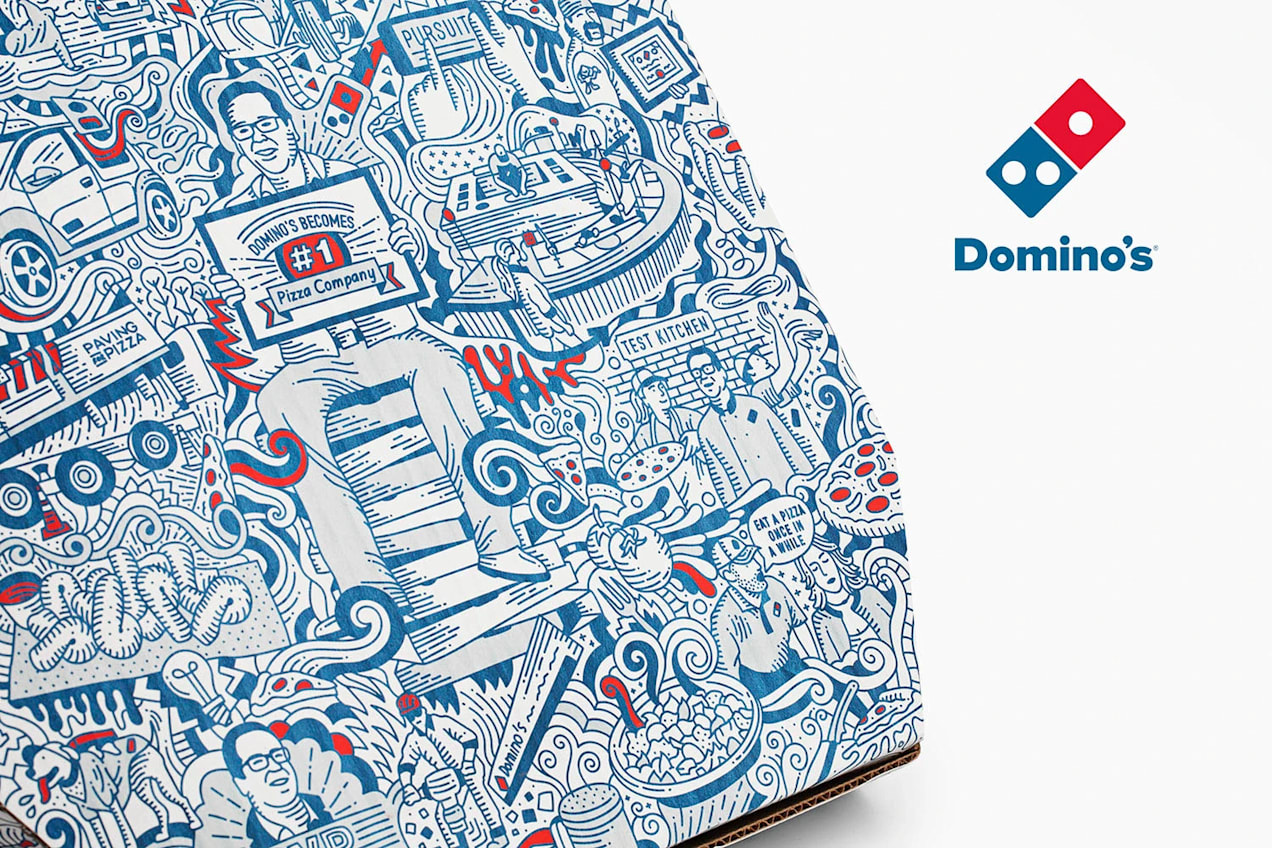
Domino’s transformation remains a masterclass in sincerity and competence. By candidly acknowledging shortcomings, overhauling core recipes and communicating with plain-spoken transparency, the brand rebuilt trust at scale. Personality shows up in the documentary tone of content, the operational clarity of the app and order tracking and the packaging hierarchy that makes decisions easy.
The company didn’t just claim change, it made changes visible and measurable. A sincere, competent brand is one that does what it says and invites customers to verify it. That loop – promise, proof and an experience that matches – has kept the personality consistent even as the menu, technology and media mix continue to evolve.

Source: Lush image by Bernice Ho via Behance
Lush
Lush blends the caregiver’s emphasis on wellbeing with a measured streak of outlaw independence. The brand’s decisions – minimal packaging, ingredient transparency, hands-on in-store demos and principled stances about digital wellbeing – are all expressions of a personality that values people over convention.
The sensory experience of the stores, the textures and colors of the products and the way staff educate rather than hard-sell all contribute to a coherent identity. Even when Lush challenges norms, the tone remains grounded in care rather than provocation for its own sake, which preserves trust with a community that expects integrity.
Pitfalls, missteps and how to avoid them
The most common mistake is trying to be everything. Long, unprioritized trait lists turn into creative mush, making assets feel inconsistent from one channel to the next. Another trap is borrowed interest: adopting the tone of the moment – snarky, hyper-casual or provocatively “real” – without the culture or operations to back it up. That mismatch gets exposed quickly and is hard to walk back. Brands also suffer from tone drift as different teams or regions interpret personality in their own ways. The antidote is a shared spec, periodic training and appointed “voice editors” who give constructive feedback.
Edginess without empathy is risky, too. Humor and provocation can work, but they require a strong sense of context and a plan for how the brand behaves during sensitive moments. Over-literal visuals are another issue: if a personality is “rugged,” that doesn’t mean every hero image needs mountains. Texture, material and lighting can communicate the same idea with more sophistication. And when you rebrand, protect continuity by preserving one or two heritage anchors such as a core color, wordmark structure or sonic cue, so you carry memory forward even as you evolve.
Evolving your brand personality over time
Healthy brands change as their audiences, categories and ambitions change. The trick is to evolve without breaking recognition. Start by diagnosing what’s no longer working: are you losing distinctiveness, entering a new market, facing cultural shifts or integrating after a merger? Instead of replacing the entire personality, adjust the mix. Often, refreshing accent traits – introducing a little more excitement, dialing back sophistication – delivers the needed energy without sacrificing equity.
Pilot changes in a sub-line or a campaign to learn quickly, then roll out with intention. Preserve continuity by keeping your anchors steady and communicating the why behind changes to internal teams and customers. Revisit the assessment every six to twelve months, not to chase novelty, but to ensure you remain legible and compelling to the people you want to serve.

Bring your brand personality to life
How people perceive your brand is subjective. But that doesn’t mean you have to leave it to chance. By actively understanding and shaping your brand’s personality, you can take your brand reputation into your own hands.
Knowing the brand personality that works best for your brand is one thing, but translating that personality into your logo, website and merchandise is another. Once you know what you’re trying to achieve you can bring your brand personality to life in all aspects of your branding.
Brand personality FAQs
What’s the difference between brand personality and brand identity?
Personality is who you are – your traits and the promises they imply. Identity is how those traits appear in the world – your design system, voice and behaviors across touchpoints. Personality informs identity, identity expresses personality.
How many personality traits should we have?
Focus on three core traits and assign relative weights to each so teams can make consistent choices under pressure. If you need variety for a campaign, introduce one accent trait temporarily rather than rewriting the core.
How does brand personality change our design choices?
Every identity lever becomes more intentional. Logo forms, color temperature, typographic voice and imagery style all carry meaning and should be chosen to reflect your primary and accent traits. Even small details like microcopy, motion timing and sound design reinforce the experience people have of your brand.
How do we make sure our voice matches our visuals?
Create a compact, visual-first personality spec that pairs example layouts with example copy, so designers and writers solve for the same tone. Train teams with real scenarios, and appoint editors who give constructive feedback and maintain quality over time.
We’re business-to-business – does brand personality still matter?
Absolutely. B2B buyers are people making high-stakes choices with limited time. A personality that conveys competence, clarity and trust shortens sales cycles, improves perceived value and increases recall. The more complex the decision, the more helpful a clear, consistent personality becomes.